NumPy zeros(): Generating Zero-Initialized Arrays in Python
The numpy.zeros() function returns a new ndarray of specified shape and data type, initialized entirely with zeros.
Memory Preallocation & Performance: Preallocating arrays using np.zeros() eliminates resizing overhead. Define geometries with shape tuples, set precision with dtype, or clone arrays via zeros_like(). For alternative fills, see numpy.ones() and numpy.full().
1. Syntax & Formal Parameter Specifications 🔝
The numpy.zeros() function accepts array dimensions and optional configuration parameters:
# Formal syntax of numpy.zeros()
numpy.zeros(shape, dtype=float, order='C', *, like=None)| Parameter | Type | Default | Description & Operational Rule |
|---|---|---|---|
shape |
int or tuple of ints |
Required | Shape of the new array (e.g., 4 for 1D, (3, 4) for 2D). |
dtype |
data-type | numpy.float64 |
Desired numerical data type (e.g., int, float, bool). |
order |
{'C', 'F'} |
'C' |
Memory layout in RAM: 'C' (row-major) or 'F' (column-major). |
like |
array_like | None |
Reference object for non-NumPy array creation. |
| Return | ndarray |
N/A | Zero-filled array with the specified shape, dtype, and memory order. |
2. Array Shapes: 1D Vectors, 2D Matrices & 3D Tensors 🔝
Passing an integer creates a 1D vector; passing a tuple defines multi-dimensional axes:
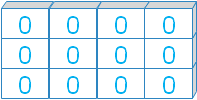 Shape (3, 4): 3 Rows, 4 Columns
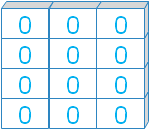 Shape (4, 3): 4 Rows, 3 Columns
# 1. 1D vector, 2D matrix, and 3D tensor initialization
import numpy as np

vec = np.zeros(4)                     # 1D vector of 4 floats
mat = np.zeros((3, 4))                  # 2D matrix (3 rows x 4 cols)
cube = np.zeros((2, 3, 2), dtype=int)   # 3D tensor (2x3x2)

print("1D Vector: ", vec)
print("2D Matrix:\n", mat)
print("3D Tensor shape:", cube.shape)
Terminal Output:
1D Vector:  [0. 0. 0. 0.]
2D Matrix:
 [[0. 0. 0. 0.]
 [0. 0. 0. 0.]
 [0. 0. 0. 0.]]
3D Tensor shape: (2, 3, 2)
3. Data Types (dtypes): Enforcing Precision 🔝
numpy.zeros() defaults to 64-bit floats (float64). Specify custom precision with dtype:
# 2. Specifying dtypes: int, bool, complex, and string
import numpy as np

z_int = np.zeros(3, dtype=int)       # Integer 0
z_bool = np.zeros(3, dtype=bool)     # Boolean False
z_cplx = np.zeros(3, dtype=complex)  # Complex 0. + 0.j
z_str = np.zeros(3, dtype='<U5')     # Empty strings

print("Integer: ", z_int)
print("Boolean: ", z_bool)
print("Complex: ", z_cplx)
print("String:  ", z_str)
Terminal Output:
Integer:  [0 0 0]
Boolean:  [False False False]
Complex:  [0.+0.j 0.+0.j 0.+0.j]
String:   ['' '' '']
4. Memory Layout Order: Row-Major ('C') vs. Column-Major ('F') 🔝
The order parameter specifies row-major ('C') or column-major ('F') physical memory layout:
# 3. Storage layout: Row-Major ('C') vs. Column-Major ('F')
import numpy as np

c_arr = np.zeros((3, 3), order='C')
f_arr = np.zeros((3, 3), order='F')

print("C-contiguous (row-major):   ", c_arr.flags['C_CONTIGUOUS'])
print("F-contiguous (column-major):", f_arr.flags['F_CONTIGUOUS'])
Terminal Output:
C-contiguous (row-major):    True
F-contiguous (column-major): True
5. Mirroring Geometries with numpy.zeros_like() 🔝
Use numpy.zeros_like() to allocate a zero array mirroring an existing array shape and dtype:
# 4. Mirroring prototype arrays with numpy.zeros_like()
import numpy as np

source = np.array([[10, 20, 30], [40, 50, 60]], dtype=np.int16)
cloned = np.zeros_like(source)

print("Source shape and dtype:", source.shape, source.dtype)
print("Mirrored zero array:\n", cloned)
Terminal Output:
Source shape and dtype: (2, 3) int16
Mirrored zero array:
 [[0 0 0]
 [0 0 0]]
6. Comparing Constructors: zeros vs. ones vs. full vs. empty 🔝
NumPy provides specialized constructors depending on your initialization needs:
| Function | Initial Contents | Speed | When to Use |
|---|---|---|---|
np.zeros() |
All zeros (0.0 or 0) |
Fast | Accumulators, image masks, zero padding. |
np.ones() |
All ones (1.0 or 1) |
Fast | Unit weights, normalization bases. |
np.full() |
Arbitrary scalar fill value | Fast | Sentinel constants (e.g. -1 or NaN). |
np.empty() |
Uninitialized memory | Fastest | Arrays immediately overwritten in loops. |
7. Production Recipes 🔝
Preallocating an image mask canvas buffer:
# 5. Production Recipe: Preallocated Image Mask / Canvas Buffer
import numpy as np

# 720p grayscale canvas buffer (height=720, width=1280)
canvas = np.zeros((720, 1280), dtype=np.uint8)

# Draw centered bounding box of white pixels (255)
canvas[200:500, 400:800] = 255
print("Canvas shape:       ", canvas.shape)
print("Active mask pixels: ", np.count_nonzero(canvas))
Terminal Output:
Canvas shape:        (720, 1280)
Active mask pixels:  120000
Creating a sliding window accumulator buffer:
# 6. Production Recipe: Sliding Window Accumulator
import numpy as np

def sliding_averages(data: list, k: int) -> np.ndarray:
    """Preallocates zero array for moving averages."""
    out = np.zeros(len(data) - k + 1, dtype=np.float64)
    for i in range(len(out)):
        out[i] = np.mean(data[i : i + k])
    return out

signal = [12.0, 14.0, 11.0, 18.0, 17.0, 16.0]
print("Smoothed averages:", np.round(sliding_averages(signal, 3), 2))
Terminal Output:
Smoothed averages: [12.33 14.33 15.33 17. ]8. Common Developer Pitfalls & Traps 🔝
Pass multi-dimensional shapes as a single tuple rather than separate arguments:
# 7. Common traps: Tuple shape omission
import numpy as np

# Trap: Passing separate ints instead of tuple raises TypeError
try:
    np.zeros(3, 4)
except TypeError as err:
    print("Caught TypeError:", err)

# Correct: Pass dimensions as a tuple (3, 4)
correct = np.zeros((3, 4))
print("Correct shape:   ", correct.shape)
Terminal Output:
Caught TypeError: Cannot interpret '4' as a data type
Correct shape:    (3, 4)
9. Interactive Practice Companion Notebook 🔝
Practice zero-array creation and buffer allocation in our companion notebook:
Interactive Companion Jupyter Notebook
Run interactive cells, test 2D/3D shapes, benchmark memory order, and run assertions.
View on GitHub Run in Google ColabSelf-Verifying Assertion Suite
Run unit assertions to verify numpy.zeros() mechanics:
# 8. Self-verifying unit test suite for numpy.zeros()
import numpy as np

# Test 1: 1D vector shape and zero values
v = np.zeros(5)
assert v.shape == (5,) and np.all(v == 0.0)

# Test 2: Multi-dimensional int matrix
m = np.zeros((3, 4, 2), dtype=int)
assert m.shape == (3, 4, 2) and m.size == 24
assert m.dtype == int and np.all(m == 0)

# Test 3: zeros_like matching shape and dtype
proto = np.ones((2, 5), dtype=np.float32)
z = np.zeros_like(proto)
assert z.shape == (2, 5) and z.dtype == np.float32
assert np.all(z == 0)

print("All numpy.zeros() unit assertions successfully verified!")
Terminal Output:
All numpy.zeros() unit assertions successfully verified!10. Frequently Asked Questions (FAQ) 🔝
What is the default data type of numpy.zeros()?
The default dtype is numpy.float64 (floating-point zeros 0.0).
Why does np.zeros(3, 4) raise a TypeError?
The 2nd argument is dtype. Pass multi-dimensional shapes as a single tuple: np.zeros((3, 4)).
What is the difference between np.zeros() and np.empty()?
np.zeros() clears all memory bits to 0, whereas np.empty() allocates uninitialized RAM buffer.
How do I create a zero array matching another array's shape?
Use np.zeros_like(array) to automatically copy shape and data type.
Further Reading & Related Tutorials 🔝
- NumPy ones() Method — Generating arrays filled with ones.
- NumPy full() Method — Generating arrays filled with arbitrary constants.
- NumPy empty() Method — Fast uninitialized memory allocation.
- NumPy Array Shape — Inspecting and reshaping multi-dimensional dimensions.
- NumPy ndarray Object — Complete architecture and attributes of NumPy arrays.
- NumPy arange() Function — Creating regularly spaced sequences.
- NumPy Master Overview — Central guide to array computing with NumPy.

Subhendu Mohapatra
Author & Instructor at plus2net
I write and maintain practical tutorials on Python, PHP, SQL, JavaScript, HTML, jQuery, and web development at plus2net. The tutorials focus on clear explanations, working examples, and code that readers can test and adapt while learning.


Subscribe to our YouTube Channel here

 Python Video Tutorials